For singers: learning a text by heart
How to memorize an aria in a language you don't speak
Most singers learn texts in languages they never studied. A foreign text stays in your memory once you know what each word means and how each sound is made, and once you have said it many times without the music. The steps below need only your score, a pencil and a dictionary. The second half of the page shows what Concert Companion adds.
Create a free account1. Learn what every word means.
Write a word-for-word translation under each line of your score, one English word under each foreign word, and a plain translation of the whole line in the margin. The word-for-word version shows you which word you sing on which note, so you know what you are saying on the longest note of a phrase.
A line whose meaning you know comes back to you as a thought. A line you only know as sounds comes back as a row of syllables, and one lost syllable can stop you.
2. Know who is speaking, and to whom.
Read the scene around the aria: what happened just before, who is on stage, and what your character wants by the end. For a song, read the whole poem, including any stanza the composer left out. Each line then has a reason to follow the one before it, and you remember the order of the lines by those reasons.
3. Learn the sounds before you sing them.
Write the IPA under the text, and ask a coach to check the sounds you are unsure of. Speak the text slowly, line by line, until every sound comes out the same way each time. Then speak it in the rhythm of the music, still without singing.
Get the sounds right at this stage. From here on, every repetition repeats a wrong vowel as faithfully as a right one.
4. Take the text away bit by bit.
Learn one line, then add the next and say both, then add a third and say all three from the top. When a line holds, cover it, write down only the first letter of each word, and say the line from those letters. Then say it from nothing.
Say the text out loud each time. Reading it silently feels like knowing it long before you do.
5. Spread the work over several days.
You remember a text better after ten minutes a day for a week than after one long evening. Each morning, say the text before you look at it: the lines you lost overnight are the ones to work on that day. You can do this part anywhere, on the train or on a walk, and your singing voice rests while you do it.
6. Put it back on the music.
Sing the aria with the score closed and mark every place where a word slips. Slips often come where two lines begin the same way, or where the music repeats and the words change. Go back to speaking just those lines. Last, write the whole text out from memory and check it against the score, word by word.
How Concert Companion helps: the text, the translation and the sounds together.
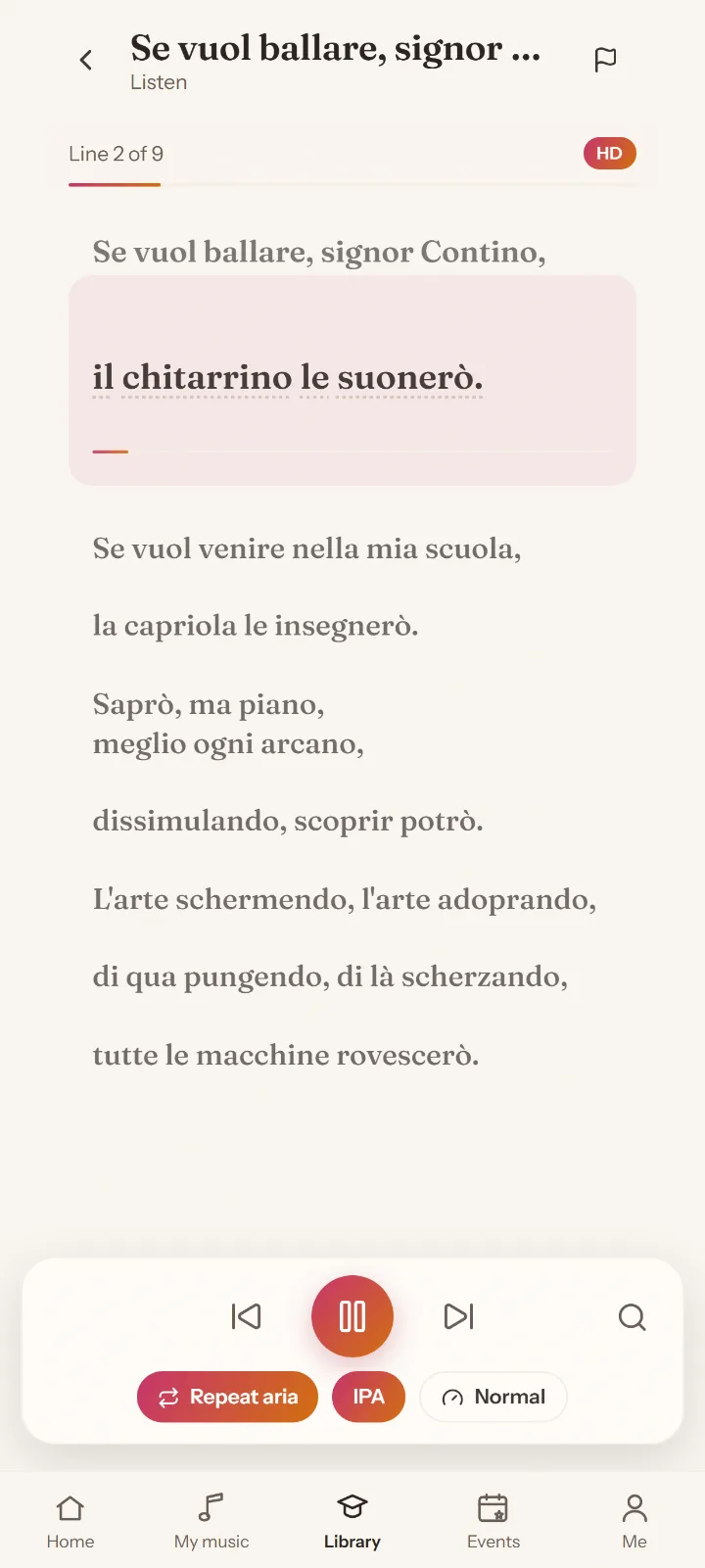
The Library in Concert Companion has more than 11,000 arias, songs and choruses with the full sung text and a translation and IPA for every line. Click a word with a dotted underline to see its literal meaning. A spoken voice reads more than 5,000 of these texts aloud in the original language, at normal speed or slower, so you can hear every sound before you say it.
Games that take the text away.
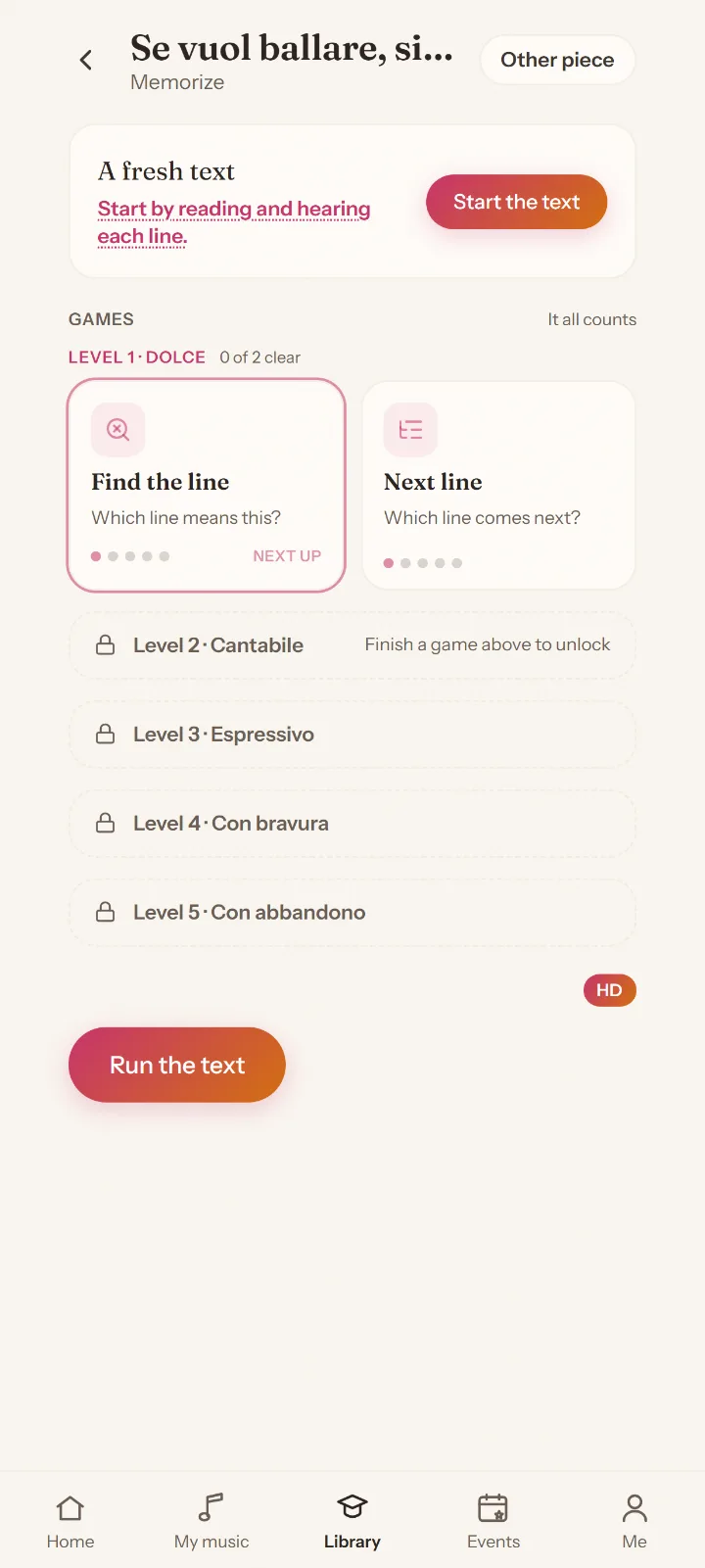
Open Learn it by heart on an aria and you find seventeen games on five levels. The first levels ask you to recognize lines: Find the line shows you a meaning and asks which line says it. Later games ask you to put the words back in order, fill in blanks and work from first letters. On the last level, Say it listens through the microphone while you say a line, and By heart shows you only the meaning. Finish a game at your highest level and the next level opens.
Listen while you walk works away from the screen. It plays a line, leaves a silence in which you say it back, and then reads the translation. You choose how long the silence lasts.
Try it on a real aria.
A free account opens Le nozze di Figaro, Messiah and Dichterliebe in full, every game included. Cherubino's Voi che sapete is a good first text.
The Library does not have every text yet. When the words of your aria are in the public domain, you can ask for it to be added. You can also paste the words of any text into My music, and the app gives it a translation and the same reader and games.