For singers of German song
Word-for-word translations and pronunciation for German lieder
A lied sets a poem, and the poem comes first. Before you sing a note, you want to know what every word means, where the verb has gone, and how each sound is made in sung German. Here is how to work that out, followed by the cycles you can open in Concert Companion with all of it written under the text.
Create a free account1. Read the poem as a poem.
Read the whole poem aloud before you look at the music, and work out who speaks and to whom. Composers sometimes repeat a line or leave out a stanza, so compare the poem with the text in your score. In a cycle such as Winterreise or Dichterliebe, read all the poems in order before you start on one song.
2. Translate it word for word.
German puts its words in an order English does not. The verb often waits until the end of the clause, and a prefix can break off a verb and land several words later. A word-for-word translation, one English word under each German word, shows you what you sing on each note.
Winterreise opens with "Fremd bin ich eingezogen". Word for word that is "stranger am I moved-in", and as an English sentence, "A stranger I arrived". Compounds come apart the same way: wunderschön is "wonder-beautiful".
3. Learn the sounds of sung German.
Singers sing German in a standard stage pronunciation, and IPA writes down each of its sounds. Check these first:
- A word that begins with a vowel starts with a short catch in the throat, the glottal stop, written [ʔ]. "Im wunderschönen Monat Mai" is [ʔɪm ˈvʊndɐˌʃøːnən ˈmoːnat maɛ].
- A b, d or g at the end of a word or syllable sounds like p, t or k: "Fremd" ends in [t]. The ending -ig is sung as [ɪç], as in "selig".
- After e, i, ä, ö, ü, ei, eu, äu or a consonant, ch is the [ç] of "ich". After a, o, u and au it is the [x] of "ach", made further back in the mouth.
- A long vowel and a short one make different words: "Staat" has a long a, "Stadt" a short one.
- For a long ü, say [iː] and round your lips; for a short ü, start from the [ɪ] of "bitte". A long ö starts from [eː], a short ö from [ɛ].
4. Speak the text before you sing it.
Speak each line slowly with the IPA beside it, then in the rhythm of the song. Sing it once the spoken line comes out the same every time. Then the hour with your coach can go to the music.
How Concert Companion helps: every line translated, every word explained.
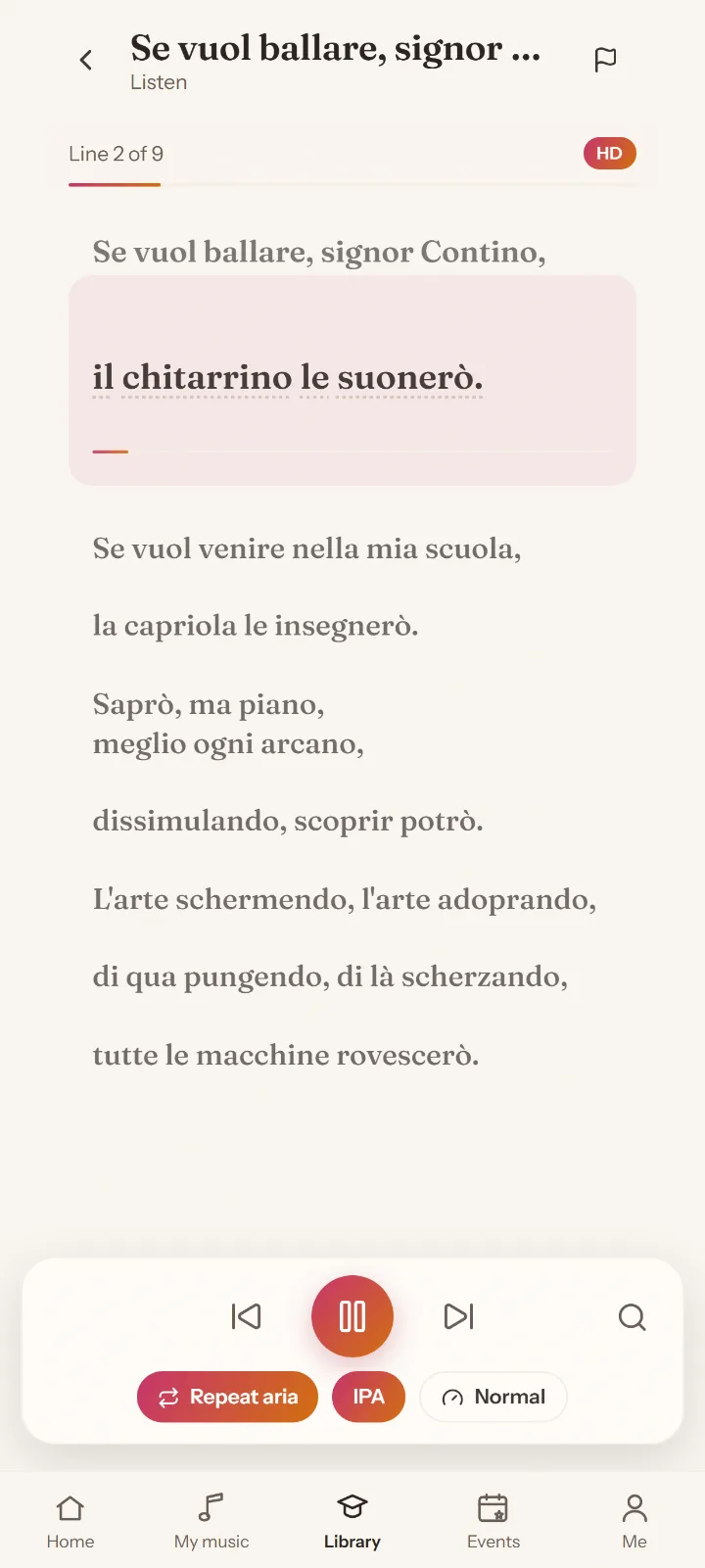
Open a song in the Library and you see the German text line by line. Under each line you can show a translation and the IPA. Click a word with a dotted underline to see its literal meaning. A spoken voice reads many of the songs aloud in German, at normal speed or slower, so you hear how each line sounds. Some songs also have notes with facts about the text.
Cycles you can open today.
These cycles are complete in the Library, with the text, a translation and IPA for every song. Schubert's Erlkönig and Gretchen am Spinnrade are there too. The Library does not have every song yet; when a song's words are in the public domain, you can ask for it to be added.
- DichterliebeSchumann, Heine, 16 songs, free in full
- WinterreiseSchubert, Müller, 24 songs
- Die schöne MüllerinSchubert, Müller, 20 songs
- Frauenliebe und -lebenSchumann, Chamisso, 8 songs
- Liederkreis, Op. 39Schumann, Eichendorff, 12 songs
- An die ferne GeliebteBeethoven, Jeitteles, 6 songs
- KindertotenliederMahler, Rückert, 5 songs
- Mörike-LiederWolf, Mörike, 53 songs
- ErlkönigSchubert, Goethe
- Gretchen am SpinnradeSchubert, Goethe
Start with Dichterliebe.
A free account opens all sixteen songs of Dichterliebe in full, games included, and three more pieces of your choice. Pro opens every song in the Library.